

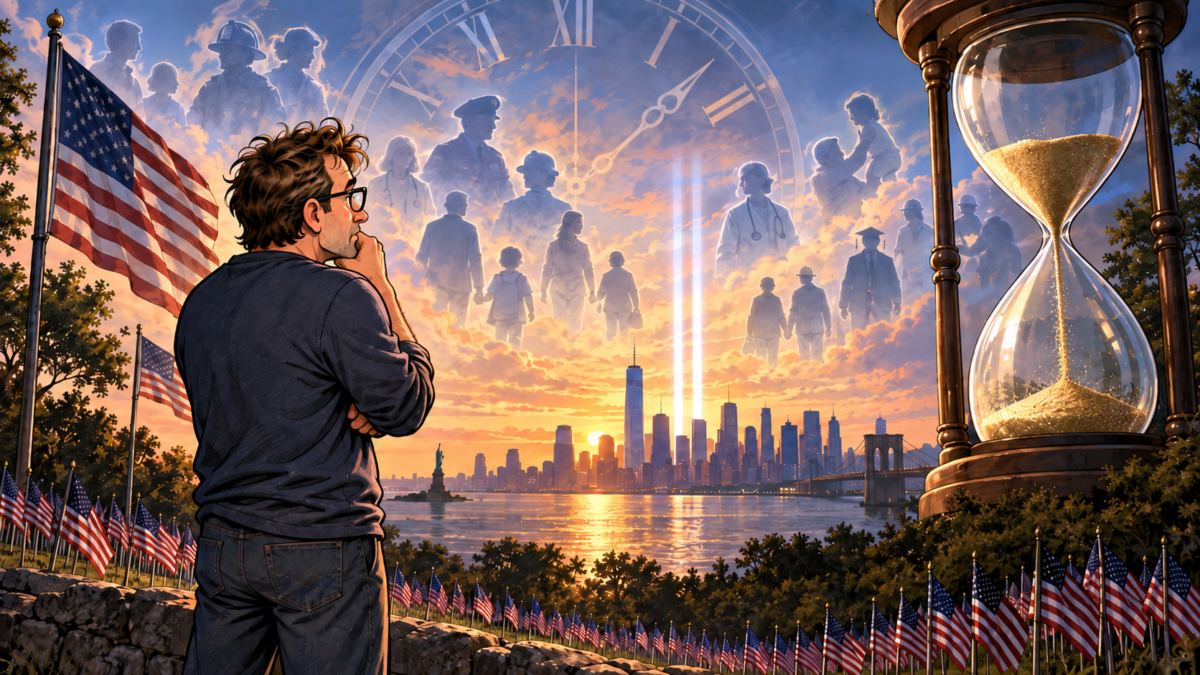
Twenty-five years ago this morning, roughly three thousand people went to work.
They set their alarms, made their coffee, kissed somebody goodbye or didn’t, got on a train or a car or an elevator, and went to work. It was a Tuesday. Tuesdays don’t announce themselves. They don’t give you any warning that this particular one is going to matter. They’re just ordinary.
Those people had plans. Not grand ones, necessarily. Dentist appointments. Fantasy football drafts. Arguments they hadn’t finished yet. A vacation somebody was already looking forward to. A conversation they kept meaning to have. A kid who needed help with homework that night. A parent they’d been meaning to call.
They had Tuesday. And then they didn’t have anything else.
We’ve had twenty-five years since then. Twenty-five years of Tuesdays, and Wednesdays, and every other day of the week. Twenty-five years of alarm clocks and coffee and grocery lists and arguments we haven’t finished yet.
I’ve been thinking about what we did with all of it.
Death has a way of making you take inventory. I don’t mean that in a greeting-card way. I mean it in the specific, uncomfortable, 2 a.m. way — where you’re lying in the dark and the math of your own life starts doing itself without your permission.
I’ve lost two people in the last year and a half who I will carry for the rest of mine.
My mother died. Forty-six years I had with her. Forty-six years of her voice, her opinions, her casette tape of Sandi Patty hymns, her particular brand of love that didn’t always look like love but was love all the way down to the bone. She was there, and then she wasn’t, and the world kept going, which is the harsh reality. The world keeps going. The mail still comes. The news is still loud. People are still arguing on the internet about things that will not matter in twenty-five years, and your mother is just — gone.
And then there’s Eliza. My daughter. She was stillborn. I never got to hear her laugh. I never got to tell her a story. I only got to hold her once. She was almost here, and then she wasn’t, and the world kept going for that too.
One of the most disorienting things about grief — and I say this as a man who has had more practice with it lately than he’d like — is that life goes on without the people we’ve lost. Not cruelly. Not indifferently. Just — relentlessly. The calendar doesn’t pause. The sun comes up. The Wild Things still need breakfast.
We moved into a new house recently. My mother will never see it. Eliza could have called it home.
I think about that more than I probably should.
So here’s the inventory I’ve been doing, and I’ll warn you it’s not entirely flattering.
Three thousand people didn’t get the last twenty-five years. They didn’t get to watch their kids grow up. They didn’t get to retire, or not retire, or change careers, or move to a new house, or plant a tree in the backyard. They didn’t get to make the mistakes we’ve made, or the good decisions either. They didn’t get any of it.
We got all of it.
Twenty-five years is a significant amount of time. In twenty-five years, you can raise a child from birth to a college diploma. You can build a career, wreck it, and build a different one. You can fall in love, fall out of it, and fall back in. You can read a few hundred books if you’re disciplined, or watch an embarrassing amount of television if you’re honest. You can learn something. You can grow. You can become, over the course of twenty-five years, a genuinely different and better person than the one you were at the start.
Or — and I hate to bring this up — you can spend a significant amount of it making mountains out of molehills, arguing over trifles, pointing fingers, and letting your life be dictated by the outrage of the week.
We have spent twenty-five years dividing ourselves into a red team and a blue team and then spending the bulk of our energy hating the other team with a fervor that would be impressive if it were directed at literally anything else. We have spent twenty-five years building an entire industrial complex of indignation — cable news, social media algorithms, comment sections — specifically engineered to make us angrier, more tribal, and more convinced that the person across from us is not just wrong but evil. We have held grudges. We have nursed grievances. We have forwarded emails we didn’t fact-check and shared posts we didn’t read past the headline and called it being informed.
We have wasted an almost heroic amount of time.
I include myself in this. I am not standing outside the glass looking in. I am very much inside the building, and the building has Wi-Fi, and I have used it poorly on more occasions than I care to count.
Now here’s the question I can’t shake, and it’s the one I want to leave with you.
Not — what would the people we lost on September 11 have done with twenty-five years, if they’d lived? That’s a different question, and it’s not the one I’m asking.
I’m asking something harder.
If they could come back right now —with full knowledge that they in fact died — if they could step back into the world as it exists today and claim the twenty-five years we’ve been given, the ones they missed — would they spend them the way we have?
Would those nearly 3,000 souls spend that time arguing about what we argue about?
Would they spend precious hours on the things we’ve spent them on?
Would they look at what we’ve done with the time they didn’t get and say, *”yes, that’s exactly right, that’s exactly what I would have wanted for those years?”
I don’t think they would.
I think they would spend them the way people spend time when they understand, with absolute clarity, that time is the only thing that actually matters. I think they would hold their people closer and their grudges looser. I think they would have less patience for the things that don’t deserve patience and more of it for the things that do. I think they would be slower to anger and faster to the table. I think they would look at the red team and the blue team and the comment sections and the cable news and the Facebook arguments and they would say, with the authority of people who know exactly what it costs to run out of time — “not this way.”
Twenty-five years ago, three thousand people went to work on a Tuesday morning and didn’t come home.
We came home. We’ve been coming home for twenty-five years.
The question — the one I’ve been asking since I lost my mother, since I lost Eliza, since I started understanding in my bones what it means when someone runs out of time — is whether we’ve been treating that like the gift it is.
I’m not sure we have. I know I haven’t always.
But today feels like a reasonable day to try harder.