

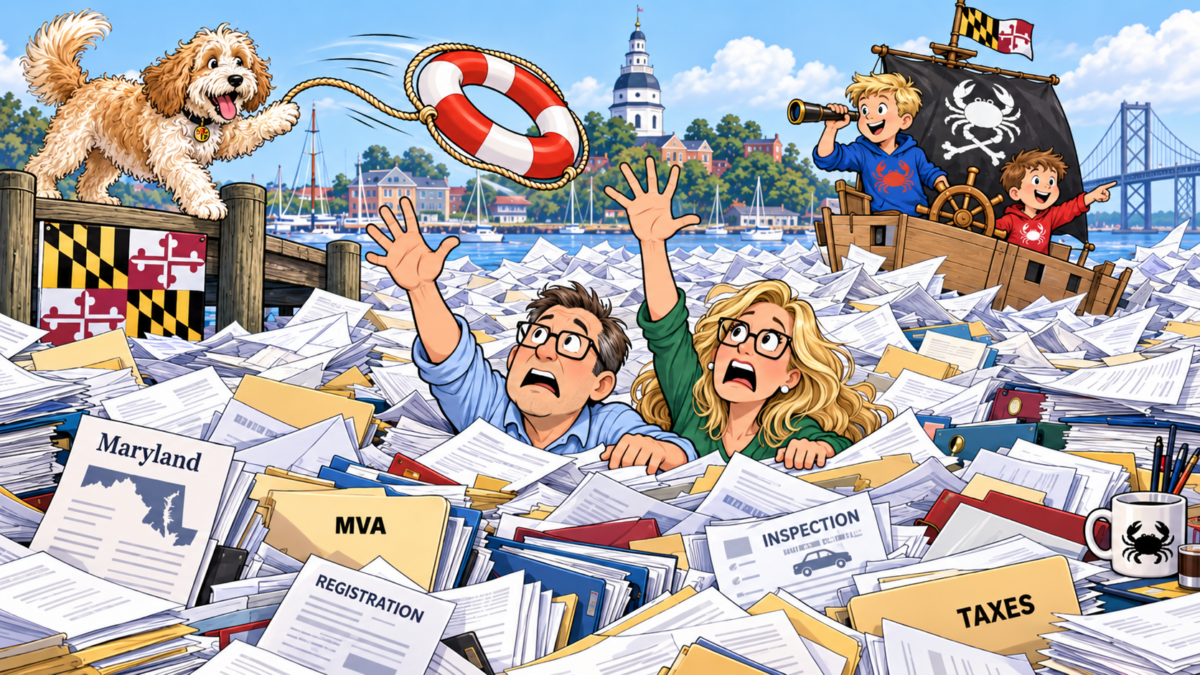
I want to be clear about something before I say what I’m about to say.
I like it here.
I genuinely, sincerely, non-sarcastically like it here. The scenery is beautiful. The community is warm. The history is staggering. The healthcare situation that brought us here in the first place has already proven itself worth every mile of that twelve-hour drive. For roughly ninety percent of the things that matter in a man’s daily life, Maryland is delivering. I have no complaints. I moved here on purpose, with my eyes open, and I would do it again.
But.
There is always a but.
We need to talk about this state’s paperwork problem.
I knew about this before I arrived. This is not a secret the state has been keeping. Maryland’s reputation for bureaucracy precedes it the way a thunderstorm precedes itself — you can feel it in the air before it gets there. People warned me. I nodded and said I understood.
I understood, but I wasn’t as prepared as I thought I would be.
I have verified who I am to at least five separate state departments. I have been to the MVA three times. Three. Times. For the same general purpose. Each time, they looked at me like I was a new person who had never been there before, which, from a paperwork standpoint, I apparently was.
Now, I am a news publisher. I worked in the newspaper business for over 20 years. I have a relationship with paper. I have wasted more paper over the years than most people have ever seen in their lifetimes. And I want you to know that the volume of paper the state of Maryland has asked me to generate, sign, notarize, copy, present in person, and occasionally re-submit in a different color ink because the information hadn’t changed. — that volume has given me pause.
You would think — and I say this as a reasonable man who has been told by at least two people that he is reasonable — you would think that at some point, one state agency might pick up the phone and call another state agency and say, “Hey, we’ve got a fella here, we’ve already verified him, he’s real, you can probably skip the part where you make him prove it again.” But alas, bureaucrats are afraid of telephones. Each agency approaches you fresh, as if you materialized out of thin air specifically to inconvenience them, and they would like some documentation about that.
Now let’s talk about the car situation, because this is where I began to have a religious experience about red tape.
When a man moves to a new state, one of the first things he wants to do is get his driver’s license and get a tag on his car. That’s what makes it official. That’s the moment you stop feeling like a tourist and start feeling like a resident. Also, the state’s websites are about as clear on registration costs as a Magic 8-Ball shaken by a toddler, so you’d like to get that financial surprise out of the way quickly.
Simple enough, right?
Oh, bless your heart.
One cannot simply go to the MVA and get your license, register one’s car, and transfer one’s title. No. First, one must get a state car inspection.
We will discuss the car inspection in greater detail another time, because it deserves its own column and possibly its own support group. But I will say this much: Maryland’s car inspection is a throwback to the era of shag carpet, ashtrays on airplanes and government officials who thought inspecting your Buick was the key to highway safety. Ralph Nader was already arguing decades ago that the country was focused on the wrong problem, and most states eventually gave up routine safety inspections anyway. The research has never shown much evidence that they meaningfully reduce crashes, and Maryland doesn’t appear to be making any real money off the program.
So what are we doing here? At this point, it feels less like public safety and more like a rain dance for bureaucrats — everybody knows the steps, nobody knows if it works, and God help you if your windshield wiper leaves a streak.
Here is the complicating factor: my wife and I drive old cars. We like to drive them until they barely have another mile in them. That is our philosophy. We are not people who trade in a perfectly functional vehicle because it has some miles on it and the new model has a fancier cup holder. We drive our cars into the ground with love and gratitude, and then we say a few words over them and move on.
Maryland’s philosophy, as expressed through its inspection process, is somewhat different. Maryland would like your vehicle to be in tip-top condition before it will affix a tag to it.
Do y’all say tag up here? In the South, it’s a tag. License plate has a certain official ring to it, but let’s be honest about what it is. The government is tagging you. For tax purposes. Like a wildlife biologist tags a bear — so they can track you and know where you are and send you a bill.
Then there is the title transfer.
I arrived at the MVA holding a perfectly valid title to my vehicle, issued by the sovereign state of Georgia, which is a real state with real laws and real government offices that apparently did their jobs just fine. And yet, I had to prove my identity again — again — and spend the better part of half an hour in conversation with the person at the counter before the state of Maryland would agree to print my ownership record on their paper.
It is very nice paper, I’ll give them that. Thick. Official-looking. Paper that communicates, without words, that the taxpayers are funding something premium. And then — because the regulations require it — the title has to be mailed to you. They cannot hand it across the counter. It must go through the postal service. Which costs money. Which the taxpayers also fund. I’m not saying it’s a racket. I’m just pointing out that I just found two ways to cut costs and lower taxes in a 30 minute appointment at just one state agency.
I have a simple proposal for the Maryland General Assembly, and I offer it free of charge, as a public service. (This, of course, is why journalists have no money — we have a horrible tendency give our pearls away for free.)
Every year, the department heads of every state agency should be required to sit down with the House of Delegates and explain, out loud, in plain English, the purpose of each piece of paperwork their department generates. Not the regulatory justification. Not the statutory citation. The actual purpose. What does this form do? What problem does it solve? What would happen if we stopped requiring it?
If they cannot answer coherently, throw the form out.
Do this for two or three years and I promise you the red tape situation improves dramatically. Because the one thing a bureaucrat dislikes more than anything — more than budget cuts, more than audits, more than a constituent with a clipboard — is being asked to explain themselves. The paperwork exists, in many cases, because nobody ever made anyone justify it. It just accumulated, the way boxes accumulate in a garage when you’ve just moved to a new house. I know a little bit about that one and if anyone would like to help me clean my garage so I can get my cars in it, I’ll take you out for pizza.
Got a minute? Got a story.
Red tape has been my nemesis since before I had a journalism degree to hang on the wall.
When I was on my high school newspaper, I pitched a story about school bureaucracy. I was a senior in high school, writing for a paper read by roughly a third of the student body, and I had questions. It took me two full semesters, several conversations with my journalism advisor, and one genuinely tense interview with the vice principal — who was not thrilled about the prospect of a teenager with a notepad asking pointed questions about administrative procedure — before I finally got was able to run the story. As I recall, the journalism advisor snuck it in at the last minute in the last edition of the year. I graduated and I never found out if he took some sort of academic bullet for me, but I’m grateful for the risk he took.
Anyway, I have been sniffing out red tape since I was a wee lad who hadn’t even gotten to journalism school yet. It is, at this point, a reflex. I see a form where a form shouldn’t be, and something in me wakes up.
I’m here now. I have no plans of stopping.
So. for all the bureaucrats in my new home state, go ahead: Print your forms. Write your regulations. Develop your procedures. Require your inspections. Mail your titles. And then pour yourself a tall glass of that unsweetened room-temperature situation you all think is tea, and get comfortable.
Because I’m going to have questions.
And unlike the last form I filled out, I will be expecting coherent answers.