

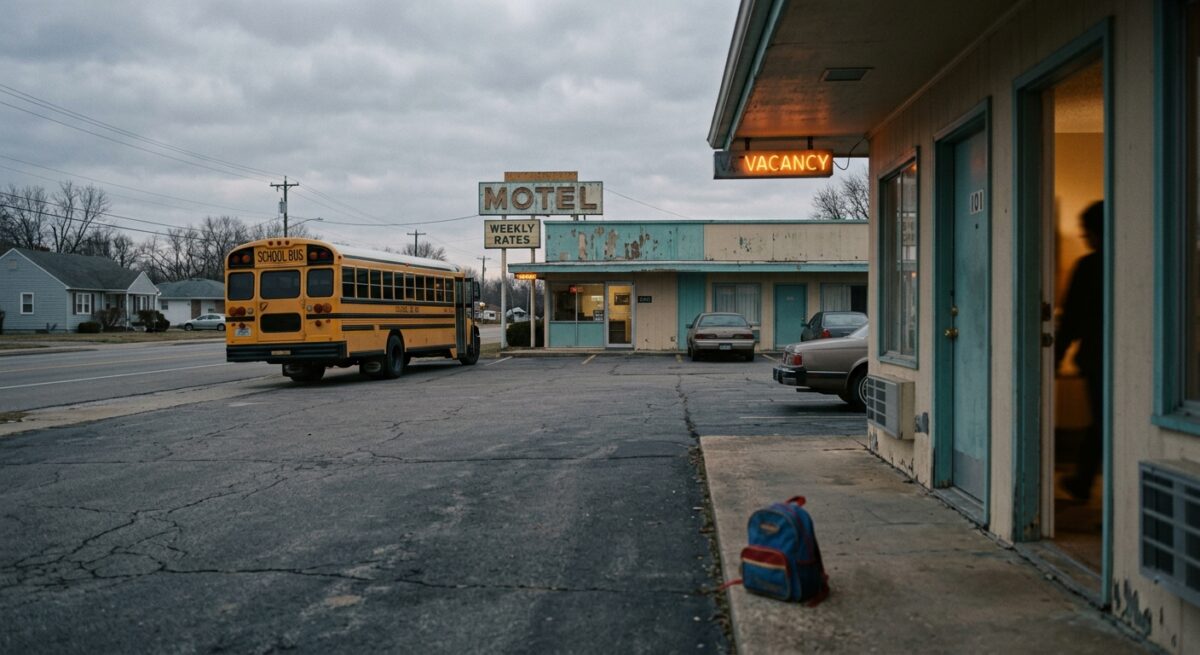
School buses pull up to hotels along Route 40 most mornings. The kids climb on, backpacks in hand, headed to class. To anyone watching from the road, it looks ordinary enough.
It is not ordinary.
Those children are homeless. Not homeless in the way most people picture it — not sleeping under a bridge or in a doorway — but homeless in the way that is easy to overlook: a motel room shared with a family in crisis, a relative’s couch, a tent. Harford County had 649 of them last school year. This year, with August and September barely behind us, schools have already identified 216 more. The count is not finished.
Those numbers came before the Harford County Council Tuesday night, presented by District A Councilwoman Nolanda Robert as part of her case for Bill 26-015, which would establish a Harford County Commission on Homelessness. The bill would create a 21-member advisory body designed to bring together the county’s scattered network of nonprofits, schools, law enforcement, health care providers and faith communities under a single coordinating structure.
“Homelessness should not define someone’s future,” Robert told the council, “and housing instability should not determine a child’s opportunity to succeed.”
The numbers, taken together, tell a tragic story.
Of the 649 students identified by Harford County Public Schools during the 2025-2026 school year as experiencing homelessness or housing instability, 373 were temporarily staying with relatives or friends. Another 164 were in hotels or motels. 63 were in shelters. 49 were in other arrangements. Nearly half — 310 of the 649 — were elementary school children.
That figure represents a an increase over the previous school year, when about 589 students were identified.
The Harford Community Action Agency’s coordinated entry system served 1,105 individuals between July 2024 and June 2026, including 327 children. Of the 109 people the agency served who were actively unhoused and seeking permanent housing, 48 were children — nearly 44% of the total.
The Harford County Sheriff’s Office estimates the county’s homeless population at somewhere between 200 and 300 individuals, depending on which definition is used. Federal standards under the Department of Housing and Urban Development count only those sleeping outside or in emergency shelters. The school system uses a broader definition under the McKinney-Vento Homeless Assistance Act, which includes children in motels, doubled-up housing and other unstable situations. The two counts cannot be added together. They are measuring different things, and that is part of the problem.
“Different counts are telling different stories,” Robert said.
The commission Robert is proposing would not resolve that definitional confusion on its own. But it could, she argued, create the infrastructure to start making sense of it — to examine where the gaps are, where services overlap, where families fall through, and what a coordinated county response might actually look like.
The proposed body would include representatives from county agencies, schools, law enforcement, health care, nonprofits, housing, business, faith communities and behavioral health. Critically, Robert said, it would also include people who have experienced homelessness themselves.
The commission would meet at least monthly and produce an annual report of findings and recommendations. It would have no authority to control county funding or operate shelters. Its value, Robert said, is in evaluation and coordination — not duplication.
She pointed to Montgomery County and Anne Arundel County as models. Montgomery has an interagency commission on homelessness. Anne Arundel has a coalition to end homelessness. Both bring government, service providers and community partners together around a shared planning table.
Harford has no equivalent structure.
The urgency of the moment was not lost on the one member of the public who signed up to speak on the bill.
“I’m tired of seeing students picked up in front of hotels with school buses,” said Hunter Baker, a resident from Aberdeen. “649 homeless students, and probably over 1,000 unhoused adults in this county — that’s probably too many for me.”
“This issue hits home to me,” he said. “I’ve been unhoused before myself.”
He urged the commission to get to work immediately. Winter, he noted, is coming.
District B Councilman Aaron Penman, who said he had personally gone out during winter months to check on homeless residents as part of a community program, expressed support for the bill. “Collaboration, putting all these resources in one place to try to combat that — I think is an excellent thing,” he said.
The public hearing closed Tuesday. The council is expected to take up the bill at its next meeting.
The 216 students newly identified this school year are still going to class. The buses are still stopping at the hotels. The count is still not finished.
- Harford's Homeless Kids: 649 unhoused students hidden in plain sight
- music history Archives – The Harford County Sun
- Havre de Grace formalizes civilian safety team after shooting in Bulle Rock
- No Kings rally in Harford County Saturday
- Harford County parents can weigh in on next school year's calendar