

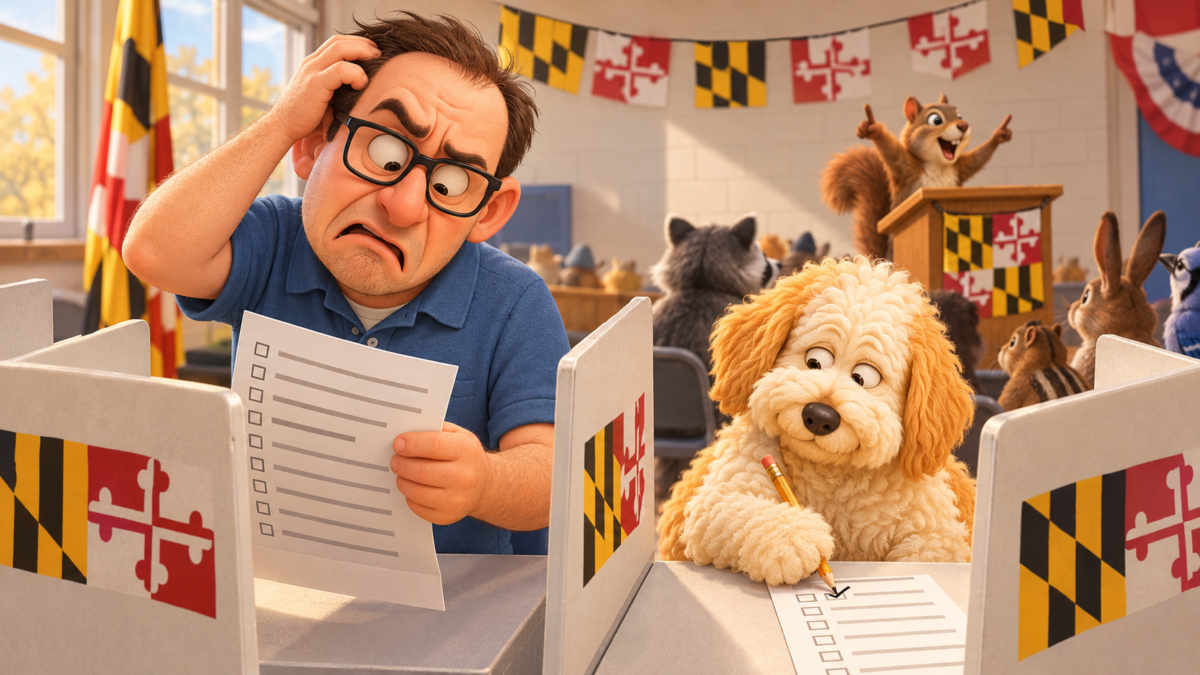
Well, it finally happened. After 790 miles, one white-knuckle MVA visit, approximately four months of eating Old Bay on things that have no business wearing Old Bay, and enough Maryland paperwork to insulate a small barn, I have officially cast a ballot in the great state of Maryland.
I voted early last week. First Maryland election. I’d like to say it felt like a solemn civic moment — a new chapter, a man planting his flag in his adopted homeland. Mostly it felt like ordering at a deli counter, but we’ll get to that.
First, let me explain something about journalists and voting, because most people don’t think about this and it’s one of those quiet little ironies that nobody outside the newsroom ever notices.
I have spent more than twenty years in the news business. In that time, I have written more words in defense of the First Amendment than I care to count. Freedom of speech. Freedom of the press. The whole beautiful, messy, loudmouthed enterprise. I believe in it with the fervor of a Baptist preacher talking condemning alcohol.
And yet.
When I registered to vote, I didn’t register with a party. I never have. Most journalists don’t. It’s one of those unwritten rules of the trade — if you’re going to cover everybody fairly, you can’t be seen flying anybody’s flag. So while I will go to the mat for your right to holler your political opinions from the rooftop, I have spent two decades hollering nothing myself. We are, professionally speaking, the people who hold the megaphone for everyone else and then stash it in the basement when it comes to ourselves.
It’s a little like being a bartender who doesn’t drink. Philosophically committed to the enterprise. Personally abstaining.
Now, here’s where Maryland threw me a curveball I did not see coming.
Maryland has closed primaries. That means if you’re not registered with a party, you don’t vote in the primary. Period. The door is closed. You may stand outside and read the menu, but you are not eating.
Back in Georgia, we had open primaries. Any registered voter could walk into any party’s primary and cast a ballot. You want to vote in the Republican primary today and the Democratic primary next cycle? Georgia said go right ahead, friend, here’s your ballot, bless your heart. The only thing you couldn’t do was vote in one party’s primary, but the other party’s runoff. Whichever side you picked in the primary, you had to pick for the runoff.
But in Maryland, I don’t get to vote in partisan races in the primaries. I’m registered unaffiliated, so I have to stay out of party politics.
Having experienced both options, I can see the argument for both systems, I genuinely can, and I have no opinion on which one is correct. On the one hand, in Maryland, only the party faithful, the diehards get to vote in primaries, and that seems fair. Someone who isn’t a republican or a democrat probably shouldn’t pick the party’s nominee. On the other hand, in an open primary system, moderate and independent voters can try to sway the primary to make sure that the person each party chooses is actually someone they feel they could vote for. I can see both sides and I don’t need to pick one.
But I will say that discovering I cannot vote in a Maryland primary was a surprise. Different rules. Different world. A man adjusts.
Alright. Now. On to the voting experience itself.
I walked in, found the right table, and the poll worker looked up at me pleasantly and asked for my name, my date of birth, and my home address.
That’s it.
No driver’s license. No voter registration card. Three pieces of information — information that, if we’re being honest with each other, is not exactly classified. My name and address are publicly available. My birthday might take a little longer, but it isn’t private info. My pharmacist knows it. Any doctor I’ve been to knows it, and the DMV definitely knows it. I’ve given it to them three times now. Theoretically, if someone wanted to vote in my place, they could do it with information they could find before finishing their morning coffee.
Now, before you start thinking I’m picking up your particular political torch, I should note that Maryland did make me prove who I was when I registered. Extensively. I felt like I was applying for a security clearance. I had to present a birth certificate, an old photo ID, and a social security card. They had to verify that I was who I claim to be and who I think I am.
But there is a gap — a notable gap — between the vault door on the front end and the screen door on the back end, and I noticed it.
In Georgia, you show ID at the polls. I know that’s controversial. I am not here to litigate it But I’ll tell you this: even before Georgia had a voter ID law, you couldn’t just walk into the polling place and say “Jack Smith, 200 Maple Avenue, October 23,” and get your ballot. Before voter ID, Georgia required you to produce something like an electric bill. They’d match your name and address on the bill to what you told them. It wasn’t perfect, but it was a step. It was a thing. It was more than three pieces of information a stranger could recite from memory.
And here is where I must tread very, very carefully, because I am aware that Georgia’s 2020 election became one of the most scrutinized, argued-over, litigated, and scrutinized elections in modern American history. I am aware of this. I covered elections in Georgia. I voted in Georgia for years.
So I say this softly, the way you’d mention to a new friend that their parking brake might be on: based on my personal experience voting in Georgia and covering Georgia elections, the process there felt more secure. Not perfect. Not without its own complications. But more secure.
I say this not to start an argument. I say this the way you say to your 80 year old mother, “I think you might have left the stove on.” I know the stats. I know that voter fraud is such a minuscule fraction of the overall vote that you’d be hard-pressed to seriously claim it is actually even malignant. But, there’s also something to being above reproach, especially when people make assumptions about how secure elections are.
I’m also open to the idea that I could be wrong. It’s certainly happened before. But, what kind of journalist would I be if I didn’t mention something I noticed. If nothing else, it’s different.
Different doesn’t mean worse. Maryland does a lot of things differently than Georgia, and most of them have turned out fine. Some of them have turned out to involve Old Bay in places I still haven’t made peace with. But different isn’t a verdict. It’s just an observation.
I voted. It counted and for the first time I got a Maryland sticker declaring I voted. It made me feel official. Full disclosure, there were a few races I didn’t vote in and I didn’t vote on any of the ballot questions because I don’t feel like I know enough to make an educated decision. Maybe next election cycle I’ll have a better handle on things.

- Joppa Magnolia Volunteer Fire Company Archives – The Harford County Sun
- Who is running for Harford County Council District F?
- Who is Running For Harford County Council District C?
- Meet the Two Candidates running for Harford County Council President
- Havre de Grace police seek help identifying suspects who used a fake $100 bill at a local business