

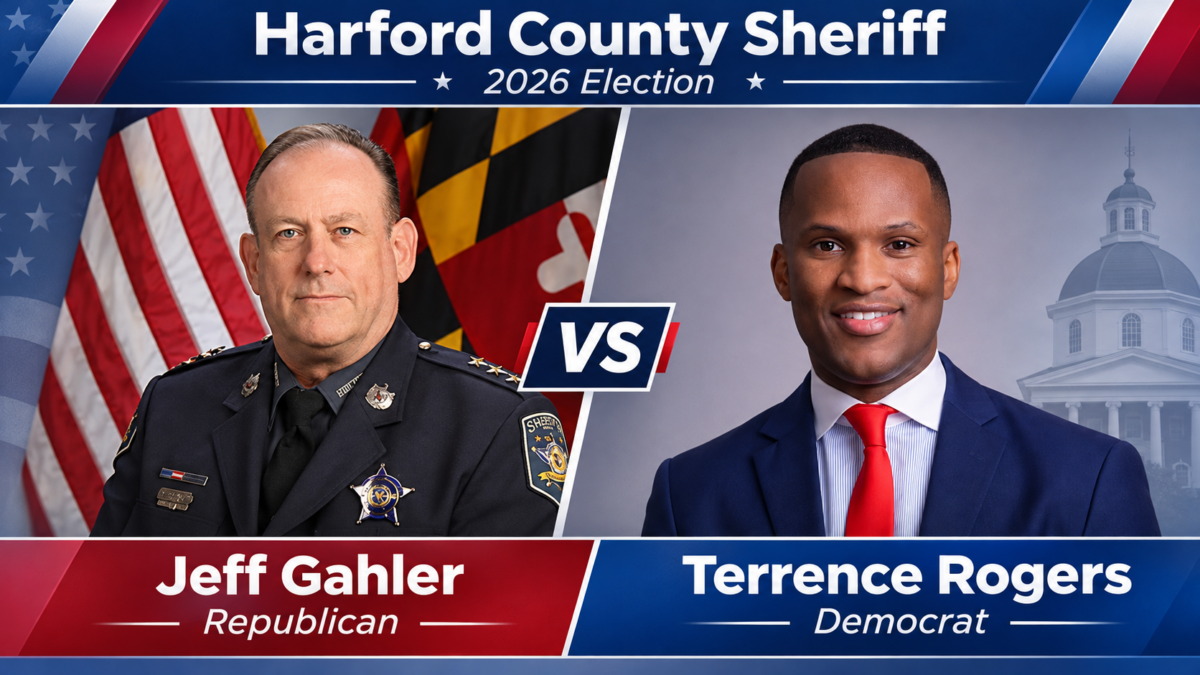
Harford County voters will choose their next sheriff on Tuesday, with Republican incumbent Jeffrey R. Gahler seeking another four-year term against Democratic challenger Terrence Rogers, a military veteran, former police officer and Baptist pastor. The race turns on questions that touch every corner of the county — how to address crime, how to recruit and keep qualified deputies, and how the Sheriff’s Office should relate to the public it serves.
Gahler responded directly to questions submitted by The Harford County Sun. Rogers did not submit answers to the newspaper’s questionnaire; his positions are drawn from publicly available information.
Who They Are
Jeffrey R. Gahler came to the sheriff’s office after 28 years with the Maryland State Police, where he worked criminal investigations, intelligence, patrol supervision, barrack command and vehicle safety enforcement before moving into senior management. He was first elected Harford County Sheriff in 2014 and took office that December. He holds an associate degree in criminal justice from Harford Community College and both a bachelor’s and master’s degree in leadership and management from Johns Hopkins University, where he also taught public safety leadership as an adjunct faculty member. As sheriff, he oversees law enforcement operations, the county detention center, court services and agency administration — a workforce of hundreds of sworn and civilian personnel operating on a budget exceeding $100 million. He has served as president of the Maryland Sheriffs’ Association and participates in the National Sheriffs’ Association, including its border security work. He lives in the Forest Hill area with his wife, Sonya.
Terrence Rogers brings a background that spans military service, law enforcement and ministry. He served as a police officer with both the Maryland Transportation Authority Police and the Aberdeen Police Department before pursuing graduate education and a career in pastoral work. He holds a bachelor’s degree in criminal justice and a Master of Divinity from Duke University, with a focus on prison reform, and has pursued doctoral studies in leadership and justice at Union Theological Seminary. His campaign biography identifies Alderson Broaddus University and Duke University among the institutions he attended. Rogers has worked in ministry, youth mentoring and community engagement, building relationships across generations and with faith communities, families and neighborhood organizations. His campaign platform centers on what he calls the B.R.A.V.E. Public Safety Plan — a five-part framework addressing crime reduction, internal accountability, community visibility, staffing and organizational culture.
The Biggest Challenges
Crime and Public Safety
Gahler identifies violent crime, drug trafficking, organized retail theft and repeat offenders as the central public safety threats facing the county. “Harford County remains a safe and vibrant place to live, work, and raise a family,” he wrote in his questionnaire, “and I am proud of the work our Office has accomplished to maintain that standard.” He argues that preserving that standard requires what he calls “consistent attention, proactive strategies, and strong partnerships.”
Rogers, in his B.R.A.V.E. plan, proposes using crime analysis to identify where violent crime, repeat offenders, motor vehicle theft and drug overdoses are concentrated — then adjusting deployments to match documented need. His stated operational approach involves identifying risks, eliminating threats and measuring whether current strategies are working. He also supports prevention through school programs, youth mentoring and neighborhood partnerships.
Both candidates support using crime data to direct law enforcement resources, and both emphasize prevention alongside enforcement. Where they differ is in starting point: Gahler points to existing crime-reduction initiatives and proposes building on them, while Rogers proposes a systematic review of current strategies before determining where changes are needed.
Staffing and Resources
Gahler calls recruiting and retaining qualified law enforcement and correctional personnel “a statewide challenge” and argues that Harford County must meet it head-on. “Competitive compensation, effective training, modern equipment, and adequate facilities,” he wrote, are “essential to attracting top candidates and supporting the personnel who serve our residents.” He specifically identifies the Central Precinct and Training Academy project as a key investment in the office’s long-term capacity.
Rogers addresses the same problem from a different angle. His B.R.A.V.E. plan proposes housing incentives and signing bonuses to help with recruitment, along with expanded health and wellness services, mandatory wellness appointments following critical incidents and stronger training and performance evaluations. He also emphasizes internal organizational culture — listening to deputies, improving employee appreciation and treating personnel fairly regardless of rank or assignment — as essential to keeping qualified people on the job.
Both candidates identify staffing as critical to effective law enforcement. Gahler’s emphasis falls on compensation, facilities and technology, including the Central Precinct project. Rogers’s emphasis falls on targeted recruitment incentives, workplace culture and structured wellness programs.
Government Policy and Accountability
Gahler argues that decisions at the state and local level directly affect what law enforcement can accomplish. “Our community deserves policies that protect families, hold offenders accountable, and enable public safety professionals to work effectively within the law,” he said. He advocates cooperation with local, state and federal partners and has said he will continue to push for legislation he believes would give deputies additional tools for addressing repeat criminal behavior.
On immigration enforcement specifically, Gahler previously operated a 287(g) agreement with U.S. Immigration and Customs Enforcement, which allowed trained sheriff’s deputies to perform certain federal immigration enforcement functions. Maryland enacted legislation in February 2026 — Senate Bill 245 and House Bill 444 — prohibiting state and local agencies from entering into or maintaining such agreements. That law required existing arrangements to end. Gahler’s campaign focuses on continued cooperation with federal law enforcement partners within the bounds of applicable law, and he has publicly opposed the state restrictions. Forms of criminal law enforcement cooperation between local and federal agencies remain permissible under Maryland law; the 2026 legislation specifically targets formal immigration enforcement agreements of the 287(g) type.
Rogers approaches the policy and accountability question differently. His B.R.A.V.E. plan calls for semiannual public accountability briefings, independent audits, stronger compliance with the Maryland Public Information Act, a public transparency portal for department data and policies, and consistent public reporting following critical incidents. He advocates enforcing the law while treating residents with dignity and respect — a principle his campaign describes as “protection with dignity.” His published platform does not establish a detailed position on immigration enforcement arrangements comparable to Gahler’s stated stance.=
Their Priorities
Reducing Crime
Gahler’s first priority, as he described it, is to “continue safeguarding the safety and security of Harford County residents” by building on existing crime-reduction efforts. “I will build on our crime‑reduction efforts through intelligence‑led policing, targeted enforcement, and strategic investments in training and technology,” he wrote. He also identifies school safety, community partnerships and prevention programs as central to that mission.
Rogers, in his League of Women Voters response, identified prevention through proactive partnerships as one of his three top public safety principles. His B.R.A.V.E. plan proposes expanding existing youth programs, introducing spring and summer youth engagement initiatives, organizing a Teen Take Over outreach program and assigning deputies as community liaisons. He frames crime reduction as inseparable from community relationships — arguing that consistent neighborhood presence and youth engagement are as important as enforcement.
Holding Offenders Accountable
Gahler makes accountability for dangerous offenders an explicit priority, including people who commit crimes while unlawfully present in the United States. “Working within established law,” he wrote, “I will continue collaborating with local, state, and federal partners to identify threats and protect our community.” He also says he will advocate for legislation that gives deputies additional tools to address repeat criminal behavior.
Rogers supports targeting repeat offenders and using crime analysis to improve investigations. His platform emphasizes consistent standards and constitutional treatment of residents and people in custody. His campaign’s accountability proposals focus primarily on the internal operations of the Sheriff’s Office — independent audits, transparent reporting and public briefings — rather than on specific enforcement arrangements with federal agencies. His published materials do not establish a detailed position on immigration enforcement policy.
The distinction between the two candidates on this question is one of emphasis. Gahler makes immigration enforcement cooperation an explicit and named priority. Rogers’s published platform centers accountability on departmental transparency and public trust.
Supporting Deputies
Gahler describes supporting the men and women of the Sheriff’s Office as a core priority. “Our deputies and civilian professionals deserve competitive compensation, robust training, appropriate equipment, and meaningful wellness resources,” he wrote. He also identifies advancing the Central Precinct and Training Academy project as directly connected to the quality of service the office provides to the public.
Rogers proposes housing incentives and signing bonuses to assist with recruitment, along with expanded health and wellness services and mandatory wellness appointments after critical incidents. His B.R.A.V.E. plan also calls for stronger supervision, improved leadership standards and better performance evaluations — changes he frames as essential to building an agency culture where qualified people want to stay.
Both candidates treat personnel as foundational to everything else the Sheriff’s Office does. Gahler’s proposals center on compensation, facilities and continuation of the Central Precinct project. Rogers’s proposals center on targeted recruitment tools, internal culture and structured wellness and supervision programs.
Where They Stand
Harford County voters are choosing between two candidates who share a number of broad goals — data-driven policing, crime prevention, better-equipped deputies and stronger community relationships — but who differ in approach, emphasis and experience.
Gahler is asking voters to continue and expand what his office has built over more than a decade, with particular emphasis on intelligence-led enforcement, school safety, training facilities and cooperation with federal law enforcement within the limits Maryland law now allows. He has a record in the office and is running on it.
Rogers is proposing a management approach built around systematic review of existing practices, greater public transparency, targeted recruitment incentives and deeper neighborhood engagement. He brings a background that crosses law enforcement, military service and ministry, and he frames public trust as inseparable from effective public safety.
Election Day is Tuesday, November 3, 2026. Polls in Maryland open at 7 a.m. and close at 8 p.m. Voters who are in line by 8 p.m. are entitled to cast a ballot.
- Meet the Two Candidates running for Harford County Council President
- Photos: 2 people rescued after falling through ice on Gunpowder River
- Havre de Grace police seek help identifying suspects who used a fake $100 bill at a local business
- I am a Maryland voter… and I'm a little confused about it
- Who are the candidates running for Harford County Sheriff?